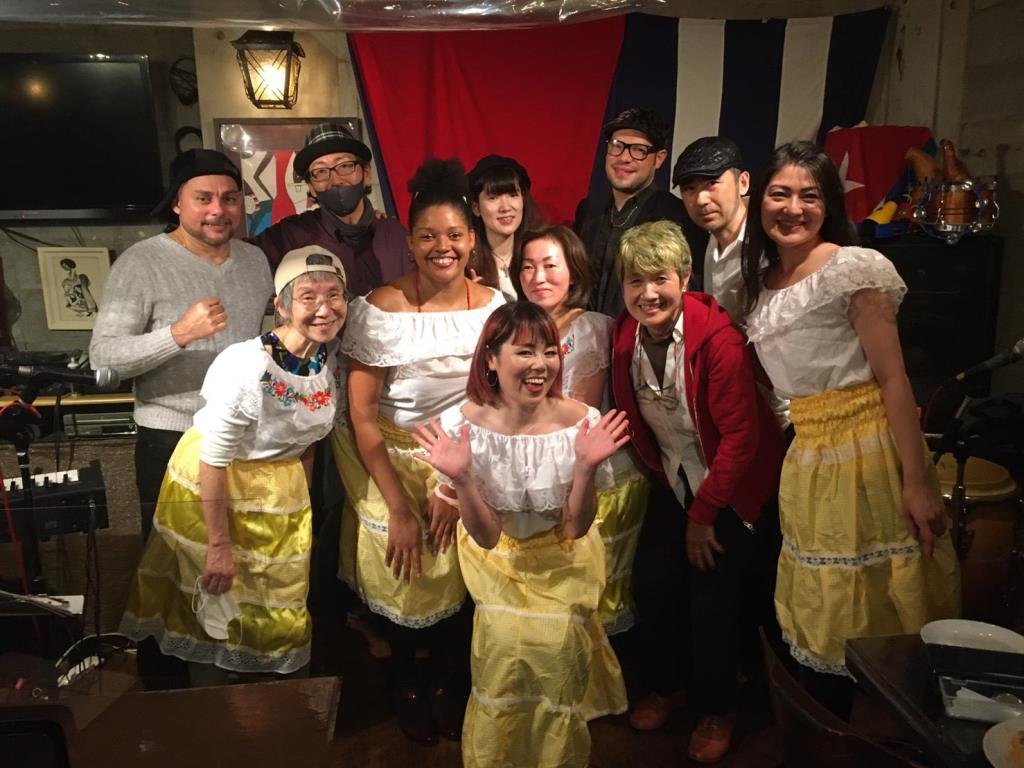
Letting oneself be defined by the degree one has studied means closing doors to other opportunities. That is clear to Anayanci Daudinot Valdés, a 29-year-old Cuban biologist who has been forging ahead in Tokyo for quite some time based on initiative, effort and the desire to succeed.
She teaches Spanish, English and salsa dancing to several Japanese students, and her dream is to set up an academy founded on the ties between Japan and Cuba. This undertaking is not based on a whim, but on her experience and desire to excel as a professional.
Although her academic training is based on biology, this young woman from Old Havana has shared her knowledge of English since she was a teenager. She has been offering Spanish lessons since 2013, and began teaching salsa ten years ago. Arriving in the commotion of a megacity like Tokyo did not daunt her and, first things first, she sought various ways to immerse herself in the local language.
From a Japanese Sunday school in a Catholic church, to exchange classes with a friend, to a government school to get to a business-level command of Japanese, Anayanci combined her studies with multiple jobs. She worked with Yokohama cruise ships, a restaurant and the Hello Sensei website, where she received her first student offers. “I kept working and doing everything because since I came here it’s been full steam ahead. Because I had to learn more about the culture and I had to learn how to manage on my own. Because when you come here it’s like riding the train of the future.”
One of the most famous language schools in Japan, the ECC Foreign Language Institute, welcomed her as a Spanish teacher. Today she works in a kindergarten teaching English, and on Saturdays she offers her mother tongue to pre-university students. “I do all this because I want to have my own academy and I must gain experience. I have already taught all ages, from children aged 1 to 6 years old, teenagers, adults in college, in their thirties and forties, and even seniors. In fact, the oldest of my Spanish students is 75 years old, and in the salsa classes I have an 80-year-old lady who dances very well,” she explains.
In addition to this, Anayanci dedicates her savings to the funds for her academy and, although there are other Spanish teachers in Tokyo, she has identified that the small number of Cubans (about 500 in the country and some 200 in the capital) are an advantage for her business, in addition to the attraction that many Japanese feel towards our culture.
“My biggest dream for now is to create my academy, which would be like a cultural center with languages, dance and the work of my husband, who is a music teacher. So it would be like a kind of cafe where concerts can be held.” Finally, having a name and a space for the company will allow her “to open a door to those people who still don’t know about Cuba, about Latin America.”
La filosofía de Anayanci también se basa en no renunciar a ningún sueño y, de hecho, volver a la biología aun aparece como opción para ella, quizás a través de un vínculo entre esta, la antropología y los lazos entre Cuba y Japón porque, según refiere, en Tokio también necesitan de esa alegría característica del cubano.
Anayanci’s philosophy is also based on not giving up on any dream and, in fact, returning to biology is still an option for her. Perhaps through a link between biology, anthropology and the ties between Cuba and Japan. As she says, Tokyo could also do with that characteristic Cuban joy.